
Today’s lesson was about the principles of design and how it influences the viewer. In this blog post discuss
–> what principles of design is present in the artwork you discussed with your peers?
–>what was the artist intent when creating this piece?
–> what is your opinion of this artwork? Do you like it or not? Please explain your answer.
In the post you must put the image of the artwork, artist name, and year it was created. Below is an example of how the image should look with artist name and year. You will need to caption the image for this technique.
NOTE: This post must be 6-8 complete sentences. Images must be added and formatted.
Submit your blog post link here when completed and make sure you publish and press turn-in in google classroom.

Pieter Bruegel the Elder, The Harvesters, 1565
Pieter Bruegel the Elder, The Harvesters, 1565
Bruegel’s fanfare for the common man is considered one of the defining works of Western art. This composition was one of six created on the theme of the seasons. The time is probably early September. A group of peasants on the left cut and bundle ripened wheat, while the on the right, another group takes their midday meal. One figure is sacked out under a tree with his pants unbuttoned. This attention to detail continues throughout the painting as a procession of ever-granular observations receding into space. It was extraordinary for a time when landscapes served mostly as backdrops for religious paintings.
Photograph: Courtesy the Metropolitan Museum of Art

Gustav Klimt, The Kiss, 1907-1908
Gustav Klimt, The Kiss, 1907–1908
Opulently gilded and extravagantly patterned, The Kiss, Gustav Klimt’s fin-de-siècle portrayal of intimacy, is a mix of Symbolism and Vienna Jugendstil, the Austrian variant of Art Nouveau. Klimt depicts his subjects as mythical figures made modern by luxuriant surfaces of up-to-the moment graphic motifs. The work is a highpoint of the artist’s Golden Phase between 1899 and 1910 when he often used gold leaf—a technique inspired by a 1903 trip to the Basilica di San Vitale in Ravenna, Italy, where he saw the church’s famed Byzantine mosaics.
Photograph: Courtesy CC/Flickr/Centralasian

Georges Seurat, A Sunday Afternoon on the Island of La Grande Jatte, 1884-1886
Georges Seurat, A Sunday Afternoon on the Island of La Grande Jatte, 1884–1886
Georges Seurat’s masterpiece, evoking the Paris of La Belle Epoque, is actually depicting a working-class suburban scene well outside the city’s center. Seurat often made this milieu his subject, which differed from the bourgeois portrayals of his Impressionist contemporaries. Seurat abjured the capture-the-moment approach of Manet, Monet and Degas, going instead for the sense of timeless permanence found in Greek sculpture. And that is exactly what you get in this frieze-like processional of figures whose stillness is in keeping with Seurat’s aim of creating a classical landscape in modern form.
Photograph: Courtesy The Art Institute of Chicago/Helen Birch Bartlett Memorial Collection

Vincent van Gogh, The Starry Night, 1889
Vincent van Gogh, The Starry Night, 1889
Vincent Van Gogh’s most popular painting, The Starry Night was created by Van Gogh at the asylum in Saint-Rémy, where he’d committed himself in 1889. Indeed, The Starry Night seems to reflect his turbulent state of mind at the time, as the night sky comes alive with swirls and orbs of frenetically applied brush marks springing from the yin and yang of his personal demons and awe of nature.
Photograph: Courtesy CC/Flickr/Wally Gobetz
Pablo Picasso,, 1907
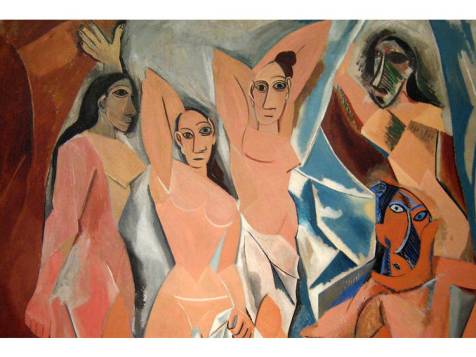
Pablo Picasso, 1907
The ur-canvas of 20th-century art, Les Demoiselles d’Avignon ushered in the modern era by decisively breaking with the representational tradition of Western painting, incorporating allusions to the African masks that Picasso had seen in Paris’s ethnographic museum at the Palais du Trocadro. Its compositional DNA also includes El Greco’s The Vision of Saint John(1608–14), now hanging in the Metropolitan Museum of Art. The women being depicted are actually prostitutes in a brothel in the artist’s native Barcelona.
Photograph: Courtesy CC/Flickr/Wally Gobetz
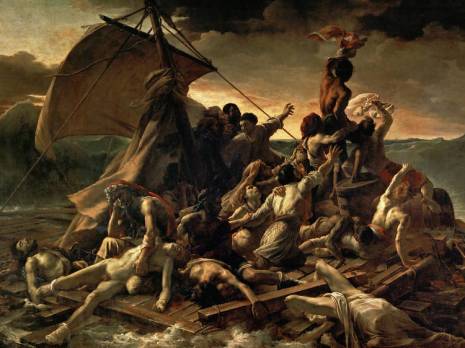
Theodore Gericault, The Raft of Medusa, 1818-1819
Théodore Géricault, The Raft of the Medusa, 1818–1819
For sheer impact, it’s hard to top The Raft of the Medusa, in which Géricault took a contemporary news event and transformed it into a timeless icon. The backstory begins with the 1818 sinking of the French naval vessel off the coast of Africa, which left 147 sailors adrift on a hastily constructed raft. Of that number, only 15 remained after a 13-day ordeal at sea that included incidents of cannibalism among the desperate men. The larger-than-life-size painting, distinguished by a dramatic pyramidal composition, captures the moment the raft’s emaciated crew spots a rescue ship. Géricault undertook the massive canvas on his own, without anyone paying for it, and approached it much like an investigative reporter, interviewing survivors and making numerous detailed studies based on their testimony.
Photograph: Courtesy CC/Wikimedia Commons
 Creative Designs and Technology Education