
Benchmark #3: Reviewing and Managing Portfolio
Step 1: Review Your Original Investment Goals
- Before making any decisions, ask yourself:
- Why did I buy this stock or investment?
- Was it for: Long-term growth? Dividend income? Stability? Speculation?
- Has my financial goal changed?
TIP: A stock should still fit the purpose it was originally chosen for.
Step 2: Evaluate Company Performance
Look at how all the companies in your portfolio are performing financially and competitively. Create a new Tab: REBALANCING MY PORTFOLIO place it under PORTFOLIO BREAKDOWN
Choose 3 Safe, 2 Risky, 1 Growth and answer these questions:
- Is the company growing revenue and profits?
- Does it have manageable debt?
- Is the company still competitive in its industry?
- Has leadership made strong business decisions?
- Are earnings meeting expectations?
Look for These Warning Signs
- Consider selling or reducing a position if:
- Revenue and profits consistently decline
- Debt becomes excessive
- The company loses market share
- Major scandals or poor management occur
- The original reason for investing no longer exists
Step 3: Analyze Stock Performance — Carefully
TIP: Do not judge a stock only by whether the price is up or down.
Rising Stock: A stock increasing in value is not always a reason to sell.
- Ask:
- Is the company still growing?
- Is the stock still reasonably valued?
- Does it still fit my long-term strategy?
Falling Stock: A declining stock is not automatically a bad investment.
- Ask:
- Is the decline temporary or due to major business problems?
- Has the overall market declined?
- Is the company still fundamentally strong?
Step 4: Check Portfolio Diversification
Review whether your portfolio remains balanced.
Questions to Ask Yourself:
- Am I too heavily invested in one company?
- Am I overexposed to one industry or sector?
- Do I still have a mix of:
- Stocks
- Bonds
- ETFs or mutual funds
- Domestic and international investments?
Step 5: Make Trades: Rebalancing Your Portfolio
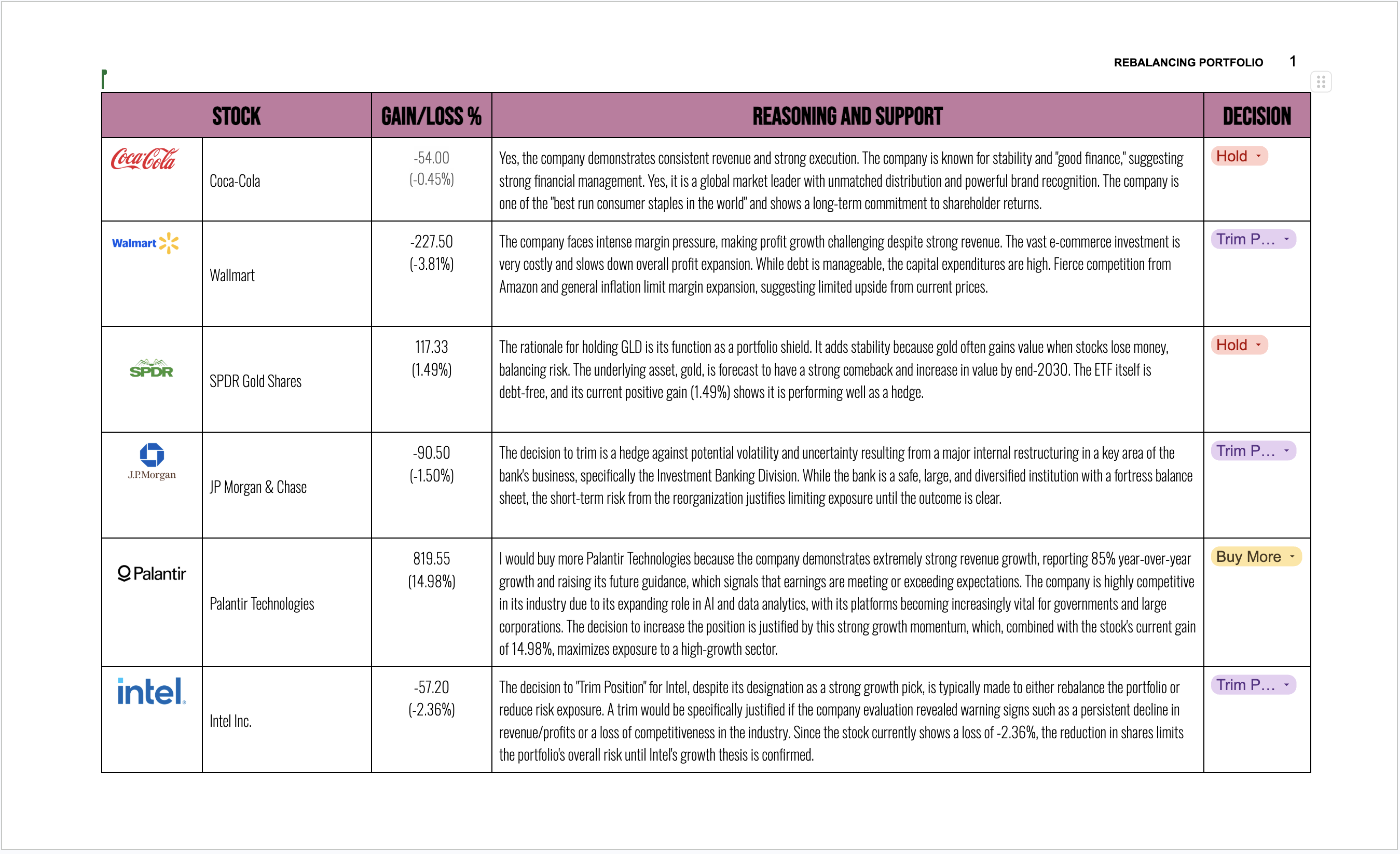
Sometimes you may sell investments simply to rebalance your portfolio.
Example: If technology stocks grow from 25% to 45% of your portfolio, you may sell some shares to reduce risk.
- To Sell Investments
- Click the investment name.
- Select Trade → Sell.
- Enter the number of shares.
- Review and confirm the trade.
- To Buy Investments
- Search for the ticker symbol.
- Select Buy.
- Enter the number of shares.
- Confirm the purchase.
- Create a Decision Framework
Use the following guide when reviewing each investment.

Portfolio Vocabulary
Hold: A hold means keeping an investment you already own without buying more or selling shares. Investors choose to hold a position when they believe the investment still fits their goals and may continue to perform well over time.
Example: A student owns 15 shares of Apple Inc. stock and decides not to make any changes during rebalancing. The student is holding the position.
Trim Position: A trim position means selling part of an investment to reduce how much of the portfolio is invested in that asset. Investors trim positions when one investment becomes too large compared to their target allocation or when they want to reduce risk.
Example: A student originally planned for one stock to make up 20% of the portfolio, but it grew to 35%. The student sells some shares to bring the investment back closer to the target percentage. This is called trimming the position.
| Decision | Questions to Answer |
|---|---|
| Hold | Is the company still strong? Does it fit my goals? |
| Sell | Has the investment thesis changed? Is risk too high? |
| Buy More | Is the company strong and temporarily undervalued? |
| Trim Position | Has the investment become too large in my portfolio? |

